The Bastas Project Brings Pressure, Resilience, and Hope to “Heavy Machinery”

Family band The Bastas Project from Woodstock, Georgia, explores the weight people carry quietly on Heavy Machinery, an eight-track album built around pressure, endurance, devotion, and the determination to keep going when life becomes overwhelming.
Released on August 11, 2026, Heavy Machinery is a melodic and cinematic rock project centered around a striking image: an industrial press bearing down on something small that somehow continues to glow underneath it.
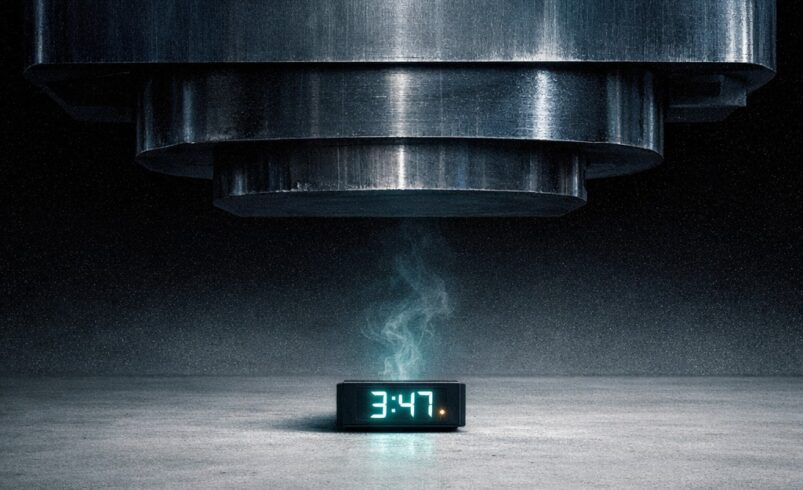
That image is represented directly on the album cover, where a heavy industrial machine presses down toward a digital clock frozen at 3:47, with steam rising from the cold steel. The clock becomes a recurring symbol throughout the project, representing the hour when sleep becomes impossible, and the mind reaches an unusual clarity on the other side of exhaustion.
Heavy Machinery moves between darkness and resistance, creating a contrast between the circumstances that threaten to overwhelm us and the parts of ourselves that refuse to disappear underneath the pressure.
Several of the album’s songs lean into the darker side of that world. “Heavy Machinery,” “Rust & Neon,” and “Shadow’s Dance” create a nocturnal, neon-lit atmosphere, with guitars pushing forward while synth textures appear around the edges. Their sound reflects the industrial imagery of the album, creating a sense of tension, isolation, and late-night uncertainty.
But Heavy Machinery does not remain in that darkness.
Tracks including “Rise Up,” “Unbreakable,” “Rivers of Gold,” and “Keep Your Gold” move in the opposite direction, opening into wide, anthemic choruses centered around endurance and self-worth. These songs focus on holding onto what is genuinely yours—your value, your people, your hope, even when circumstances are applying pressure from every direction.
The album’s most intimate moment arrives with “I Am Your Calendar,” which sits at the center of the project. Instead of the heavier industrial imagery found elsewhere on the record, the song turns inward, exploring the experience of becoming the person who keeps track of someone else’s days.
That shift gives the album an emotional midpoint, connecting its larger themes of pressure and endurance with something much more personal.
At its core, Heavy Machinery was written for people who are carrying more than they openly show. The album speaks to the exhausted, the overworked, and those rebuilding their lives after something has broken. Rather than treating these experiences from a distance, The Bastas Project turns them into songs designed to be experienced collectively.
The choruses are meant to be sung back, giving the album an element of shared release. The band’s melodic approach allows its heavier themes to remain accessible, while the cinematic arrangements give the songs room to build toward those moments of emotional release.
The Bastas Project’s identity as a family band is also an important part of the album’s character. Their music comes from the natural chemistry of people who have shared experiences and grown up together, and that closeness can be heard in the harmonies and emotional delivery.
Songs about love, distance, devotion, memory, and endurance take on another meaning when they are being created by people connected by the same family bonds. The warmth within the arrangements provides a counterbalance to the colder, mechanical imagery that surrounds much of Heavy Machinery.
That contrast is perhaps the album’s most distinctive quality: a close-knit Southern family creating melodic rock around industrial pressure and neon-noir imagery.
The setting adds another unexpected layer to the project. Woodstock, Georgia is a long way from the cold mechanical world suggested by the album’s cover and production. Yet that contrast gives Heavy Machinery part of its identity, placing intimate family songwriting against a darker sonic backdrop.
The 3:47 clock appears throughout the project’s imagery, reinforcing the idea of the sleepless night that defines much of its emotional world. The album begins with the image of a machine pressing down on something small, but its story does not end there. By the conclusion, the machine has begun to crack while the smaller object underneath remains intact.
The image becomes a visual representation of the album’s central idea: pressure can be overwhelming, but it does not necessarily get the final word.
This gives Heavy Machinery a beginning, middle, and end rather than simply functioning as a collection of individual songs. The darkness, tension, struggle, resistance, and eventual hope are connected across the eight tracks.
The Bastas Project has previously developed a catalog that has attracted attention from curators who describe their work through terms including emotional pop-rock and melodic rock. Their sound combines expressive vocals, warm guitars, steady drums, memorable choruses, and songwriting shaped by themes of love, distance, memory, and release.
Heavy Machinery pushes those qualities into a heavier atmosphere while remaining hopeful at its core.
For listeners looking for an entry point into the album, “Rise Up” offers immediate impact, “Heavy Machinery” establishes the project’s darker atmosphere, and “Rivers of Gold” provides one of its strongest emotional payoffs.
Ultimately, Heavy Machinery is about what remains when pressure has done its worst. It is about the nights that seem impossible to get through, the responsibilities that become too heavy, and the moments when simply continuing becomes an act of strength.
Through cinematic rock, close family harmonies, industrial imagery, and anthemic songwriting, The Bastas Project turns that idea into an eight-track journey about refusing to be crushed by the weight we carry.
Stream Below:open.spotify.com/album/6iZ8L2UnfQ7hJ